
%20(34).png)
Donor cultivation and donor stewardship are two of the most important concepts in nonprofit fundraising, but many organizations do not fully understand the difference between them or when to use each.
While they sound similar and both focus on the donor relationship, they serve different purposes.
Donor Cultivation vs. Stewardship: Quick Definition
Donor cultivation builds a relationship with a prospect before a gift is made.
Donor stewardship strengthens the relationship after the gift is made.
Donor cultivation focuses on acquisition, while donor stewardship focuses on retention and long-term donor value.
Both are essential, but understanding the differences will help nonprofits move donors through the full donor lifecycle, from awareness to engagement and beyond.
This guide explains:
- What donor cultivation is
- What donor stewardship is
- Key differences between cultivation and stewardship
- When to use each
- Real examples and best practices
- How both work together to increase retention and revenue

What Is Donor Cultivation?
Donor cultivation is how you build relationships with potential donors before you ask them to donate to your nonprofit.
Donor cultivation builds trust, connection, and alignment with your mission, while demonstrating the impact of support. You want to motivate donors to give, and ideally, trust your organization and believe in their ability to impact your mission.
If you’re considering how we map the donor journey, donor cultivation focuses on the awareness stage. The prospect is learning about your mission, and you’re instilling confidence in them that you can give them the role of a hero.
Donor cultivation focuses on a few key tactics:
- Relationship-building to create a personal connection between the nonprofit team member and the prospective donor.
- Education, so the prospect is well-informed about how you steward donations. If they are to become recurring donors, how is that money spent?
- Trust development. You may not think you’re competing with other nonprofits, but there are many worthy causes donors consider. If a prospect knows you and trusts you, they’ll stick around.
- Engagement before solicitation, because a cold ask for support is much harder than a warm one.
Examples of Cultivation Activities
Once you’ve contacted a prospective donor, there are many ways you can gently bring them closer to your mission.
Cultivation activities may include:
- Inviting prospects to events, whether they’re community-based (like a fun run) or a donor appreciation event.
- Sharing mission stories and impact. You can do this through targeted emails, but you can also consistently promote impact on your website, in a newsletter, or on social media.
- Sending educational emails that increase knowledge about your mission. Once a prospect learns details, they will be more invested in helping.
- Scheduling discovery meetings, which can look like a cup of coffee to discuss the work your nonprofit does.
- Reaching out personally or having your team or board reach out. This can be a handwritten note, a phone call, or a visit to your food bank or offices.
Cultivation is about helping someone care deeply about your mission before asking them for financial support. You’re paving the way for that conversation to be easier.
What is Donor Stewardship?
Donor stewardship is what happens after a donor has given. You cultivate the relationship until they give, and then you begin stewarding to maintain and strengthen it.
It’s easiest to think of cultivation limited to prospective donors and stewardship limited to active donors.
Donor stewardship focuses on a few things:
- Showing appreciation in a genuine, specific way. Rather than a generic “Thanks for your donation,” stewardship might look like, “Amy, thank you so much for your $100 donation. We were able to feed a family of four for a week because of your generosity!”
- Demonstrating impact is the same idea – how did the donation influence your mission? If you can share specific stories or photos, they can be particularly compelling.
- Building trust means that you’re seen as a responsible financial steward. If someone signs up for a monthly gift, they can trust that your payment processor is secure and their payment details are safe.
- Increasing retention is critical to your long-term success. As it’s often repeated, it’s easier to keep a donor than to find a new one. Your stewardship should deepen donor loyalty to your organization.
Stewardship activities may include:
- Thank-you calls, emails, and letters… consistently reminding donors how grateful you are for their continued support.
- Impact reports and updates, whether they’re in a dedicated email or a newsletter. When the help is specific and visible, donors are drawn in.
- Donor recognition in any form helps to steward donors. You can plan regular donor appreciation lunches or events. You can highlight different donors (not only the major donors) on your website or on social media. You can invite groups of donors to coffee with your board, or offer a token gift with every donation. When donors feel seen, their commitment grows.
- Ongoing communication is critical. While no one wants to be buried under emails, a regular cadence of check-ins validates your organization and keeps donors connected.
- Personalized engagement, automated with a nonprofit CRM, is now the norm with donor communications. Donors expect it.
When you’re considering stewardship activities, remember the goal is to simply ensure donors feel valued, informed, and motivated to keep giving.
Donor Cultivation vs. Stewardship: Key Differences
| Donor Cultivation | Donor Stewardship | |
| Timing | Before the gift | After the gift |
| Audience | Prospects and potential donors | Existing donors |
| Primary Goal | Inspire first donation | Retain and grow donors |
| Focus | Relationship building | Relationship strengthening |
| Emotional Objective | Build trust | Reinforce trust |
| Outcome | First gift | Repeat gifts and retention |
Cultivation prepares donors to give, while stewardship ensures they continue giving. Strong stewardship naturally leads to future cultivation, creating a continuous cycle of donor engagement and giving.
When to Use Donor Cultivation vs. Stewardship
You might be wondering which event would trigger either one. Here are some common scenarios.
Use donor cultivation when:
- Engaging new prospects
- Preparing for a major gift ask
- Building awareness and trust
Use donor stewardship when:
- Thanking donors after a gift of any size
- Providing impact updates
- Strengthening long-term donor relationships
Balancing cultivation and stewardship ensures nonprofits can both acquire new donors and grow sustainable, long-term fundraising revenue.
Where Cultivation and Stewardship Fit in the Donor Lifecycle
Both donor cultivation and stewardship are part of the donor cultivation cycle, which typically includes:
- Identification
- Cultivation
- Solicitation
- Stewardship
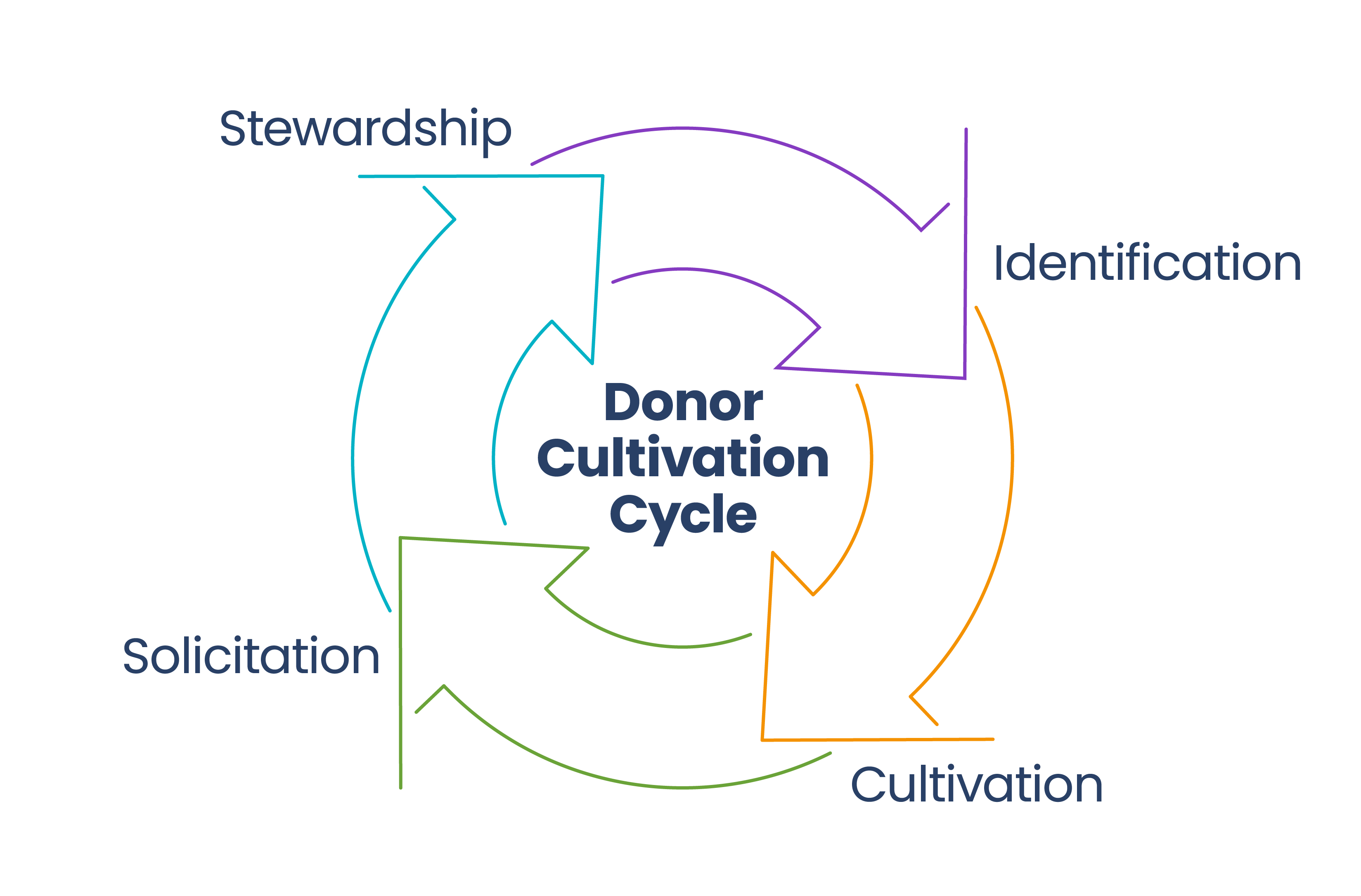
Cultivation happens right before solicitation, or the ask. Stewardship happens after. Then stewardship feeds right back into cultivation for the next gift. This helps nonprofits move donors from initial awareness to lifelong support. Nonprofits that manage this cycle effectively generate stronger donor retention and more predictable fundraising revenue.
Why Donor Cultivation Matters
Without cultivation efforts, it won't be easy to grow your donor base. After all, your job is to create relationships with the people you hope will become donors, recurring donors, major donors, etc. There needs to be that solid foundation of trust.
Benefits of cultivation include higher conversion rates, larger gift sizes, faster gift decisions, and stronger donor relationships. It helps prospects understand your mission and, more importantly, see themselves as part of it. Fundraising has to be more than transactional for it to be sustainable.
Why Donor Stewardship Matters Even More
Getting donors in the door is the critical first step, but stewardship directly affects donor retention. And donor retention is key to long-term nonprofit success.
Statistics underscore the importance of donor retention:
- Giving USA reports that first-time donors make a repeat gift 20% of the time. If they do give again, the chance of future gifts goes up 60%.
- CCS Fundraising states that 70% of participants in a study said that donor acquisition or retention is a top challenge.
- According to NonprofitPro, "Nonprofits that connect with people and invest in building relationships with them retain donors...the ways people give are changing and the competition around causes is increasing."
Acquiring new donors is challenging and expensive, but important. But retaining the donors you have is far more cost-effective and even more crucial for your nonprofit.
Stewardship drives higher donor lifetime value, increased recurring giving, stronger and more loyal donor relationships, and greater fundraising stability.
Example of Donor Cultivation vs. Stewardship
Your nonprofit identifies a potential major donor. You begin to cultivate that donor to make a donation more likely.
You might:
- Invite them to tour your facility or one of your programs
- Send them quick emails with impact stories
- Meet for coffee so you can answer questions
- Share updates on mission impact
No donation ask is made yet. The focus is on building a relationship.
The donor then makes a $5,000 gift. It's time to start stewarding that donor; the shift is to appreciation and retention.
You might:
- Send a prompt and personal thank you via a phone call or email
- Provide regular and specific updates on how the gift was used
- Inviting them to special events or offering perks, like a free table at an auction
- Recognizing their contribution publicly, if they agree
This is a donor you want to remain engaged, so your focus is on deep gratitude and drawing them closer to your mission.
Three Common Mistakes Nonprofits Make
Try to avoid these three common pitfalls.
1. Treating stewardship as optional.
Most nonprofits focus heavily on acquiring new donors because they're critical to mission impact and growth. But bringing donors in and getting a lot of one-time gifts isn't sustainable; it's a leaky bucket. Always consider stewardship to be even more important than cultivation.
2. Asking too soon.
In your haste to secure a gift, you can be tempted to rush cultivation and ask for a gift before a trusting relationship has been established. Without proper cultivation, donation requests feel transactional and are less likely to succeed.
3. Stopping engagement after the gift.
After a donation is made, continuing to engage with the donor helps them feel valued. When they are ignored, it's easy for donors to quietly drift away. If you don't have an established stewardship program, you'll lose them.
Cultivation vs. Stewardship: How Technology Helps
As we've shown, cultivation and stewardship are not separate strategies; they are two halves of the same system.
Cultivation builds trust. Stewardship reinforces trust. Together, they create lifelong donors.
Because this is an ongoing cycle, it can be made easier if you lean on your nonprofit CRM or tech stack.
Technology will help with the core components of your plan:
- Personalize communications at scale
- Track all donor interactions with your nonprofit, so you can measure the effectiveness of your cultivation and stewardship programs
- Automate workflows rather than manually sending emails
- Use wealth indicators to identify potential donors
- Catch signals that a donor is ready for an ask
Strong technology helps nonprofits execute both cultivation and stewardship consistently. A nonprofit CRM ensures no donor interactions are overlooked, improving donor retention, engagement, and long-term fundraising growth.
Frequently Asked Questions
Is donor cultivation the same as stewardship?
No, cultivation happens before a donation, and stewardship happens after the donation.
Which is more important, cultivation or stewardship?
Both are critical, and they are part of the same cycle. Cultivation helps a nonprofit acquire donors. Stewardship drives retention and lifetime value.
Does stewardship include cultivation?
Stewardship supports ongoing cultivation for future gifts, but they serve different roles in the donor lifecycle.
What is the donor cultivation cycle?
The donor cultivation cycle includes identifying prospects, cultivating relationships, soliciting donations, and stewarding donors to encourage continued support.
Which comes first, cultivation or stewardship?
Donor cultivation comes first, and happens before a donor makes a gift. Stewardship begins after the donation.
The Bottom Line: Cultivation Acquires Donors, Stewardship Keeps Them
Donor cultivation and donor stewardship are both essential for nonprofit fundraising success. Cultivation builds relationships before a donation, and stewardship strengthens them after.
Nonprofits that focus on this whole cycle will generate higher retention, higher lifetime value, more predictable revenue, and stronger donor relationships.
Fundraising isn't only about transactions. It's about deep, long-term relationships. Cultivation and stewardship help you bring in donors and retain them. Nonprofits that invest in both cultivation and stewardship build stronger relationships and generate more sustainable fundraising revenue.

Scale Your Fundraising
See how top-performing nonprofits keep a human touch while growing rapidly.
Schedule your 15-minute call%20(4).png)
.png)