
%20(17).png)
Ah, email. It remains a favorite fundraising tool. After all, it’s cost-effective, convenient, and flexible. Whether you are nurturing your donors, prospecting for new ones, promoting events, or sending out year-end appeals, the right nonprofit email marketing platform can help you deliver personalized, targeted emails—automatically.
As with most tools for nonprofits, there are a lot of options on the market. How can you tell which is right for you?
Without a crystal ball, all you can really do is…homework.
We’ll jump in and help! We’ve rounded up some solid options for you to consider. Take a look at our list, check off a few that sound good, and ask for demos.
If you want to check out a particular system, jump to it here:
2. Virtuous
3. Mailchimp
4. Bloomerang
6. Bonterra
8. Neon One
9. Salesforce
10. Klavio
There is a perfect solution for your nonprofit. Let’s see if we can help you find it.
10 Top Nonprofit Email Marketing Platforms
For each of these, we’ll offer an overview and some pros and cons, as well as tell you what type of nonprofit is a good match.
1. CharityEngine
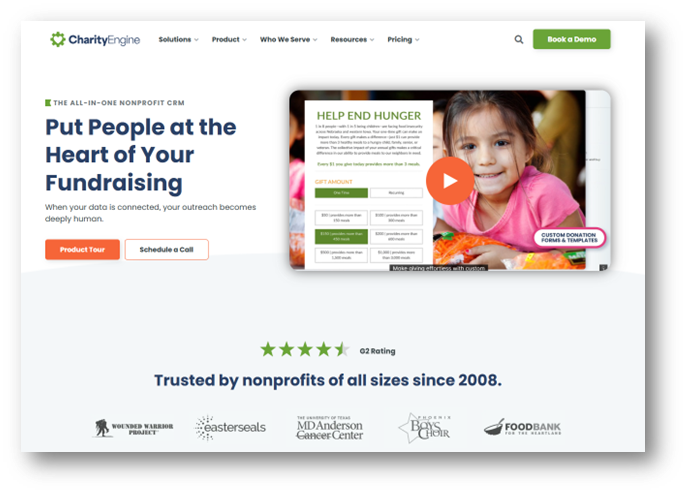
CharityEngine is an all-in-one nonprofit CRM, fundraising, and marketing platform built just for nonprofits. It offers built-in email marketing tools and automation. Because all donor data lives in one place, organizations can send highly targeted, automated campaigns that align with personal preferences, giving behavior, and engagement history.
What nonprofits love:
This system combines all your fundraising tools and data in one place, giving you a 360-degree view of donor engagement and history. The platform offers advanced segmentation and automation, strong reporting, and 99% email deliverability.
A word of caution:
The platform is robust. There’s comprehensive onboarding and training, but the smallest nonprofits might be overwhelmed.
It’s a good fit for:
Growing nonprofits looking for a unified system to run multichannel campaigns.
2. Virtuous
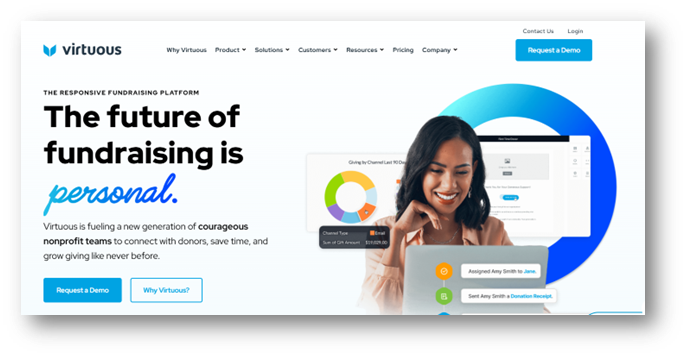
Virtuous offers responsive fundraising tools, including a robust email marketing engine. It’s designed to help nonprofits create personalized donor experiences across all channels, including email and direct mail. The company has coined the term “responsive fundraising” and published a few books about it.
What nonprofits love:
Virtuous offers a lot of personalization and dynamic content tools. Automation is based on donor behavior, and there’s a visual campaign builder. We love how Virtuous focuses on personalized donor journeys to drive effective communication.
A word of caution:
The platform is expensive, both in terms of onboarding and implementation. They don’t offer case management, which makes it hard to be really responsive to donor requests, and the platform doesn’t have custom donation forms, advocacy, auctions, or e-commerce, so clients are often cobbling together tools for desired functionality.
It’s a good fit for:
Midsize to large nonprofits that can handle a learning curve and a high price tag.
3. Mailchimp
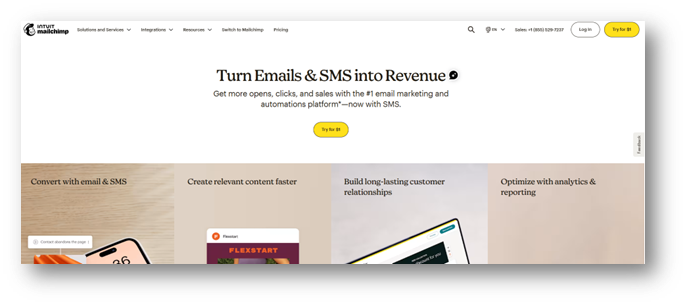
We can’t talk email marketing without talking about Mailchimp! It’s a highly user-friendly platform known for a drag-and-drop editor and automation features. It’s not built for nonprofits (or any other specific audience), but it does offer special pricing for organizations like yours.
What nonprofits love:
The smallest of teams cannot go wrong with Mailchimp. It is easy to use, offers polished templates, and you can try it for $1. The pricing is great for those starting out.
A word of caution:
Mailchimp is a general-purpose email tool designed for small businesses. It won’t provide donor-specific features, and it will get significantly more expensive as your list grows. And it’s a third-party tool, meaning you will have to integrate it with your CRM and push data into your system.
It’s a good fit for:
A small nonprofit just starting email marketing—and one that wants a low-cost option.
4. Bloomerang
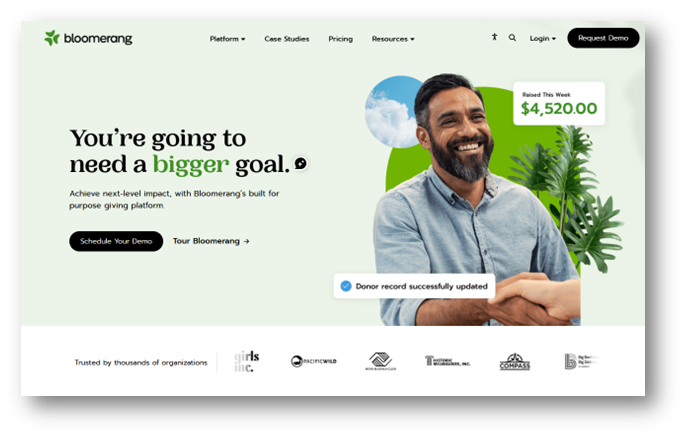
Bloomerang is a donor management platform with built-in email marketing tools. Emphasizing donor retention, it offers a straightforward user interface and segmentation, A/B testing, and templates.
What nonprofits love:
The focus on donor retention is fantastic and a critical focus for so many nonprofits. The email suite is part of the CRM, and the platform offers easy-to-read engagement tracking.
A word of caution:
Limitations. Whether it’s limitations on email capabilities, limitations on design, or limitations on other functionality growing nonprofits need, it’s hard for a rapidly growing nonprofit to have all the tools it needs.
It's a good fit for:
Nonprofits with standard requirements and a focus on donor retention.
5. Constant Contact
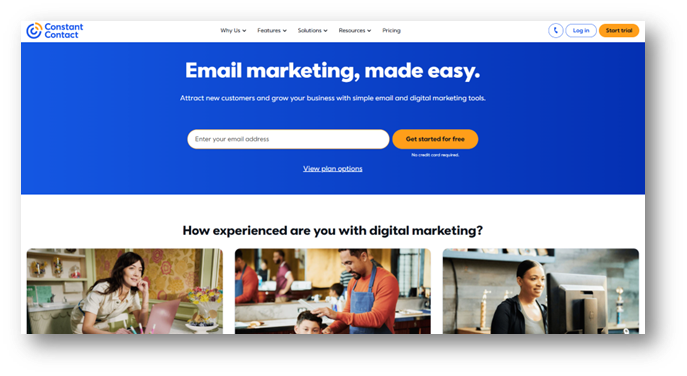
Constant Contact is another name you’ll hear a lot from smaller nonprofits. It’s a veteran in the email marketing industry, and it offers a straightforward way to build, schedule, and send email campaigns. It offers some extras, such as tools for events, surveys, and social posts.
What nonprofits love:
It’s been around for a while, and it’s a solid option for nonprofits starting out. It’s user-friendly and offers discounts for nonprofits. Deliverability is reliable, and it’s a flexible platform.
A word of caution:
If you need a CRM, and most nonprofits do, this isn’t one; it’s essentially just a basic email tool. You won’t find advanced features like automation and segmentation.
It's a good fit for:
Nonprofits that want a simple, reliable email tool, and not much more.
6. Bonterra
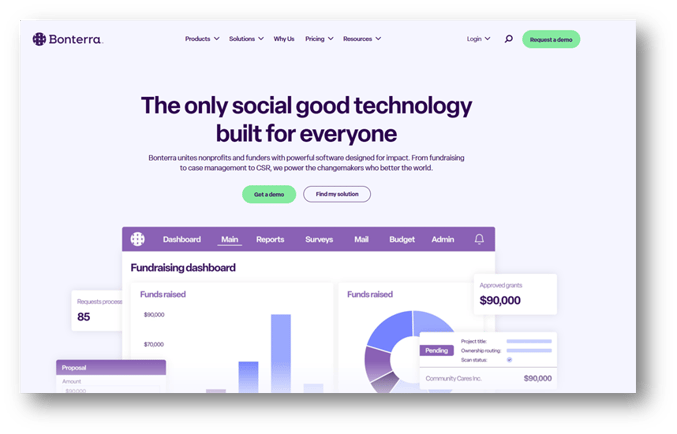
Bonterra is a nonprofit technology company that brings together several established platforms under one umbrella, including EveryAction and Network for Good. Its solutions span donor management, fundraising, engagement, advocacy, and corporate social responsibility, serving a wide range of nonprofit organizations.
What nonprofits love:
Bonterra offers purpose-built nonprofit tools rather than adapting for-profit software. Organizations appreciate its integrated fundraising and CRM capabilities, built-in email marketing, advocacy tools through EveryAction, and guided fundraising features popular with smaller and mid-sized nonprofits through Network for Good. The ecosystem approach can provide continuity as organizations grow.
A word of caution:
Bonterra is not a single unified platform. Capabilities, user experience, and feature depth vary depending on which Bonterra product you implement. Organizations should carefully evaluate whether they are purchasing EveryAction, Network for Good, or another Bonterra solution, as integrations and scalability may differ.
It's a good fit for:
Nonprofits that want nonprofit-specific software from an established provider and are looking for solutions tailored to either grassroots advocacy and political fundraising (EveryAction) or streamlined, guided fundraising tools for small to mid-sized organizations (Network for Good).
7. HubSpot Marketing Hub
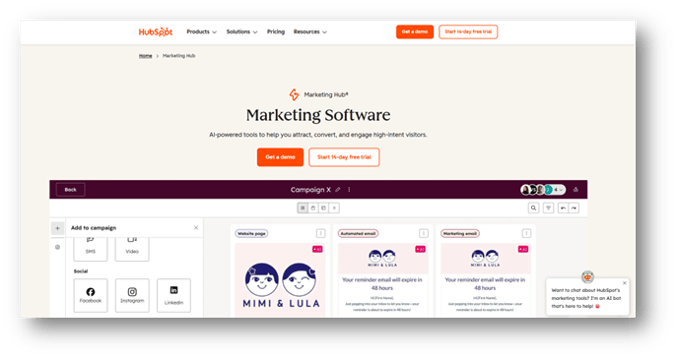
HubSpot Marketing Hub is a comprehensive marketing platform that includes email marketing, automation, landing pages, marketing analytics, and deep CRM integration. It’s not nonprofit-specific, but many charities choose it for its ease of use and powerful automation capabilities.
What nonprofits love:
Nonprofits appreciate HubSpot’s best-in-class marketing automation, including intuitive visual workflows that make it straightforward to build supporter journeys. It integrates seamlessly with the free HubSpot CRM, allowing organizations to unify donor and supporter data in one place. The platform also includes built-in landing pages, forms, and reporting tools that don’t require developer support, along with advanced personalization and segmentation capabilities that scale as campaigns become more sophisticated.
A word of caution:
HubSpot’s pricing can increase steeply as contact volumes and feature tiers grow, and its nonprofit-specific discounts vary by region and eligibility. Some organizations also find the breadth of features overwhelming if they’re just starting with email marketing.
It's a good fit for:
Nonprofits that want powerful automation, strong inbound marketing tools, and a unified CRM and email system that supports growth from early adoption to advanced supporter journeys.
8. Neon One
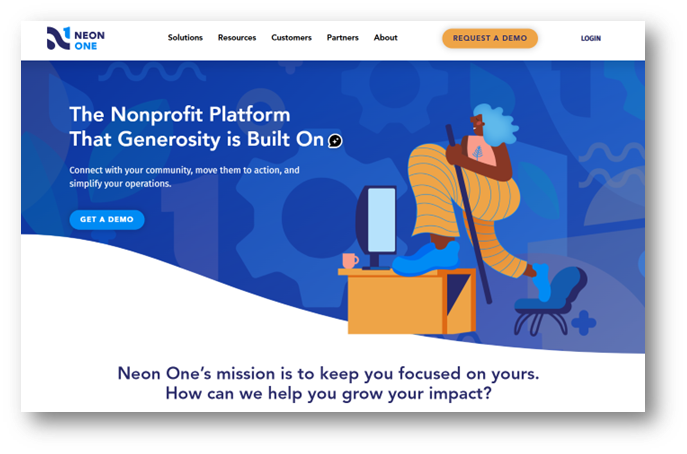
Neon One offers a connected product ecosystem, including email marketing tools, and allows for segmentation, email automation, and tracking within a centralized CRM.
What nonprofits love:
Neon offers a CRM and email, as well as decent opportunities for customization and automated triggers based on donor activity.
A word of caution:
The company talks about connectivity, but most tools aren’t built into the system. That means your data is still going to be siloed, and it will be hard to get a complete view of how donors are engaging with your nonprofit.
It's a good fit for:
Nonprofits that don’t mind a lot of integrations, as long as they’re all connected in one platform.
9. Salesforce for Nonprofits + Marketing Cloud
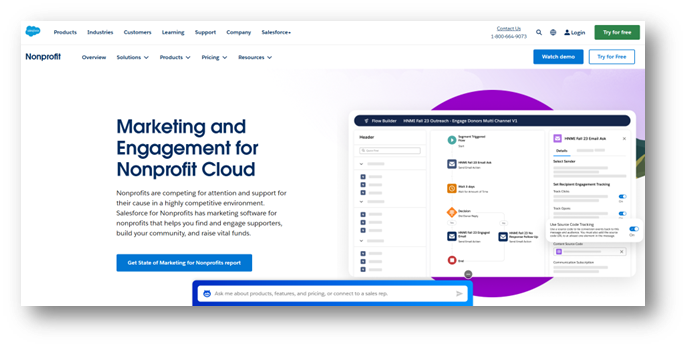
Salesforce is not for the faint of heart. It’s a heavyweight CRM that, when paired with the Marketing Cloud, offers advanced email marketing capabilities, including journeys, dynamic content, and AI-powered recommendations.
What nonprofits love:
Salesforce has provided industry-leading software for decades, and it lives up to its reputation. The platform offers incredible customization and scalability as well as robust personalization.
A word of caution:
Can we be frank? Salesforce is expensive and complex. Many nonprofits that like the Salesforce reputation find themselves quickly overwhelmed.
It's a good fit for:
Large, even enterprise, nonprofits with internal tech support
10. Klaviyo
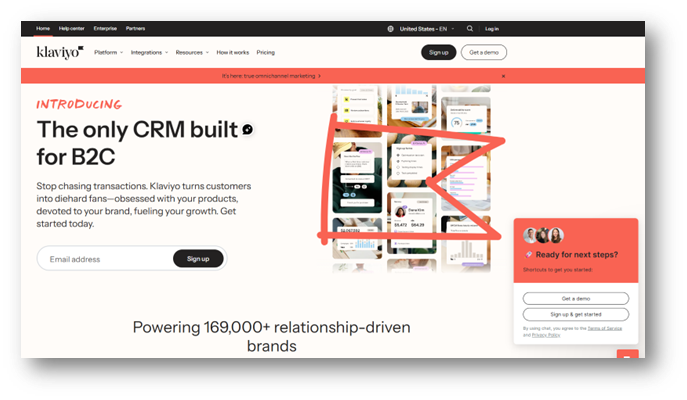
Klaviyo began as an e-commerce platform, but nonprofits are increasingly drawn to its powerful automation, segmentation, and data-centric approach to email marketing.
What nonprofits love:
Nonprofits find Klaviyo offers excellent automation and real-time segmentation. The analytics suite is impressive, too.
A word of caution:
If you’re looking for a CRM, you won’t find it here. It’s not designed for nonprofits, so even the advanced features don’t necessarily play to nonprofit needs.
It's a good fit for:
It’s a particularly good fit for mid-sized and growing nonprofits that treat email as a strategic revenue channel, not just a broadcast tool.
The Best Nonprofit Email Marketing Platform for Your Nonprofit
Nonprofit software is personal. It’s worth your time to review this list, cross a few off, star a few, and reach out for demos. You’ll know when you find a perfect match.
The right platform will depend on goals, team size, internal resources, and required integrations. It will depend on how many emails you want to send and how many contacts you have.
If you want to consolidate fundraising, donor management, and email marketing into one system, check out CharityEngine, Virtuous, and Bloomerang.
If you’re just starting out or you want something very basic, take a look at Mailchimp or Constant Contact. They’ll help you grow without overwhelming you.
No matter which you choose, email will remain one of the most powerful tools you’ve got to engage your donors. With the right platform, you’ll be able to tell your story, rally supporters, and build lasting relationships to increase the impact on your mission.

Scale Your Fundraising
See how top-performing nonprofits keep a human touch while growing rapidly.
Schedule your 15-minute call-1.png)
.png)
%20(26).png)